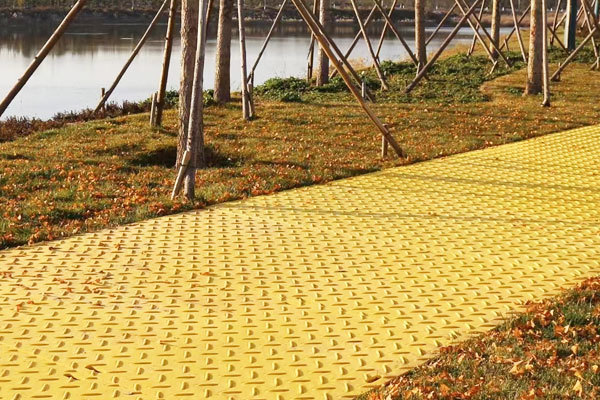
Ground protection mats, also referred to as temporary road mats, construction access mats, or heavy-duty ground mats, are modular, reusable engineered panels designed to safeguard ground surfaces, stabilize working environments, and improve site safety across industrial, commercial, and event scenarios. As essential temporary site solutions, they effectively address common on-site problems such as ground rutting, soil compaction, mud accumulation, and equipment sinking, serving as a cost-effective and eco-friendly alternative to traditional temporary road construction.
Core Working Principle
The fundamental function of ground protection mats lies in load distribution and pressure dispersion. Heavy machinery, vehicles, and pedestrian traffic generate concentrated point pressure on the ground, which easily damages soft turf, loose soil, wetland, asphalt, and other sensitive surfaces. With high structural rigidity and large contact area, these mats transfer concentrated vertical loads to a wider horizontal range, greatly reducing unit ground pressure. This mechanism prevents surface subsidence, soil erosion, and pavement damage, while providing a flat, stable, and anti-slip working platform for equipment and personnel.
Premium Material Selection & Advantages
Modern high-performance ground protection mats are mainly manufactured from HDPE (High-Density Polyethylene) and UHMWPE (Ultra-High-Molecular-Weight Polyethylene), with a small number of lightweight rubber and composite mats for low-load scenarios. Industrial-grade HDPE mats have become the mainstream choice for global projects due to their comprehensive superior performance, featuring the following core advantages:
-
Extreme Load-Bearing Capacity: Professional heavy-duty mats can withstand 150–200 tons of static and dynamic load, compatible with cranes, excavators, dump trucks, and other large construction equipment, meeting the load demands of most engineering projects.
-
All-Weather Durability: The polymer material is resistant to ultraviolet radiation, low temperature, rainwater corrosion, and chemical erosion. It will not crack, deform, rot, or fade in extreme environments such as high-temperature summer, freezing winter, rainy muddy seasons, and saline-alkali wetlands, ensuring long-term stable service.
-
Lightweight & Reusable: Compared with traditional wooden and steel road plates, HDPE mats are lightweight, easy to carry, splice, and disassemble without heavy mechanical assistance. They can be reused for hundreds of times, greatly reducing project auxiliary costs and construction waste.
-
Eco-Friendly & Low Maintenance: The material is non-toxic and pollution-free, protecting vegetation and ecological environment without damaging the original terrain. The smooth and dense surface is not easy to adhere to mud and dust, requiring only simple flushing to clean, with extremely low later maintenance costs.
Key Product Features
Standard ground protection mats adopt an integrated modular design with scientific structural optimization, covering multiple practical functional features to adapt to complex site conditions:
-
Anti-Slip Surface Design: The textured or patterned surface increases friction coefficient, effectively preventing vehicle skidding and pedestrian slipping in rainy, snowy, and muddy conditions, fully improving site operation safety.
-
Fast Splicing Structure: Equipped with professional buckle connection systems, multiple mats can be quickly assembled into complete temporary roads, working platforms, and pedestrian passages. The splicing gap is tight without displacement or warping, ensuring overall structural stability.
-
Water & Mud Drainage Design: Partial mat styles are designed with drainage grooves and mud leakage holes, which can quickly drain rainwater and filter sediment, avoiding water accumulation and mud stratification on the mat surface to keep the site clean and unobstructed.
-
Flexible Adaptability: The mats have moderate toughness, can fit uneven ground such as slopes, depressions, and sandy land, and are suitable for various complex terrains including grassland, beach, wetland, desert, and construction rubble ground.
Wide Industry Applications
Thanks to their strong adaptability and high cost performance, ground protection mats are widely used in multiple industries, becoming a standard supporting facility for temporary construction and activity layout:
Construction & Infrastructure Engineering
Used for temporary construction roads, equipment working platforms, and material storage areas on construction sites. They prevent road mudification and ground damage, ensure smooth passage of engineering vehicles, and avoid rework and loss caused by ground subsidence, effectively improving construction efficiency.
Landscape & Greening Projects
In garden construction, lawn maintenance, and green space renovation, the mats protect turf and vegetation from rolling and crushing by construction machinery. They realize zero damage to the original green landscape, meeting the environmental protection and construction requirements of municipal greening and scenic spot renovation projects.
Large-Scale Events & Outdoor Activities
Ideal for temporary passage and venue laying of concerts, sports meetings, outdoor exhibitions, wedding ceremonies, and festival activities. They protect lawns and square pavements, solve the problem of muddy ground after rain, and provide safe and tidy walking and activity spaces for crowds and service vehicles.
Energy & Resource Projects
Widely applied in oil and gas fields, wind power construction, photovoltaic base construction, and mining operations. In remote and complex terrain such as wilderness and wetlands, they build stable temporary access roads to ensure the smooth progress of equipment transportation, installation, and daily maintenance operations.
Emergency & Municipal Maintenance
Used for emergency rescue passages, municipal pipeline maintenance, and road rush repair scenarios. The rapid laying feature enables quick formation of safe passages for rescue vehicles and construction personnel, providing strong support for emergency disposal and urban infrastructure maintenance.
Selection & Usage Tips
To maximize the service value of ground protection mats, targeted selection and standardized use are required according to actual project demands. For light-load scenarios such as pedestrian passages and small vehicle passages in event venues, lightweight thin-type mats can be selected; for heavy-load engineering scenarios with frequent passing of large machinery, it is necessary to choose thickened industrial-grade high-load-bearing HDPE mats.
During laying, the ground should be simply leveled first to remove sharp hard objects to avoid local stress damage to the mats. The mats should be firmly spliced and fixed to prevent displacement and gaps. After use, timely cleaning and proper stacking storage can effectively extend the service life and improve the reuse rate.